Wi-Fi Repeater vs Extender
Introduction
Wi-Fi Repeater vs Extender is a common comparison because these terms are often used interchangeably. Both devices are designed to help improve Wi-Fi coverage when the signal from a router does not reach a particular area effectively. However, the terminology can be confusing because many modern networking products marketed as Wi-Fi extenders also perform repeating functions.
In practical use, the main difference is usually related to how the device connects to and extends the existing network. A traditional repeater receives a wireless signal and retransmits it, while a Wi-Fi extender is a broader term that can describe different methods of expanding Wi-Fi coverage. Therefore, understanding the specific device and its connection method is more useful than relying only on the product name.
Quick Comparison Table
| Feature | Wi-Fi Repeater | Wi-Fi Extender |
|---|---|---|
| Main purpose | Repeats an existing Wi-Fi signal | Extends Wi-Fi coverage |
| Typical connection | Wireless | Wireless or wired, depending on model |
| Receives router signal | Usually through Wi-Fi | Through Wi-Fi or Ethernet |
| Coverage expansion | Yes | Yes |
| Ethernet support | Depends on model | Available on some models |
| Performance | Depends on wireless link | Depends on connection method |
| Setup | Usually simple | Usually simple to moderate |
| Best use | Basic wireless signal extension | Broader range of coverage solutions |
| Terminology | More specific | Broader term |
| Cost | Often affordable | Varies by model and features |
What Is a Wi-Fi Repeater?
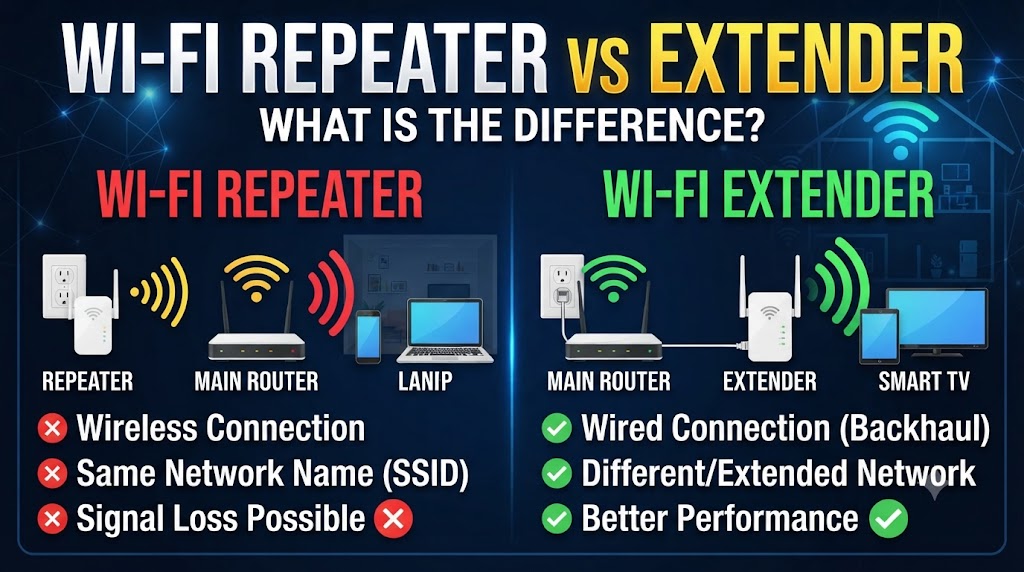
A Wi-Fi repeater is a networking device that receives an existing Wi-Fi signal and retransmits it to extend wireless coverage.
The basic arrangement is:
Router → Wi-Fi → Repeater → Wi-Fi Devices
The repeater communicates wirelessly with the router and then rebroadcasts the signal.
This can help devices connect in an area where the router’s normal Wi-Fi coverage is insufficient.
How Does a Wi-Fi Repeater Work?
A repeater needs to receive a usable wireless signal from the main router.
For example, if the router is located in a living room and the signal becomes weak in a nearby room, the repeater can be positioned between those areas.
However, the repeater should not normally be placed in the area where there is already almost no signal. It needs a reasonably good connection to the router to repeat that connection effectively.
What Is a Wi-Fi Extender?
A Wi-Fi extender is a broader term for a device designed to expand the coverage of a Wi-Fi network.
Many Wi-Fi extenders work in a similar way to traditional repeaters. They connect to the existing Wi-Fi network and provide coverage farther away from the main router.
However, some products marketed as extenders can also support Ethernet connections or other networking modes.
The term extender therefore does not necessarily describe one specific technical method.
Wi-Fi Repeater vs Extender: Are They the Same?
In many consumer products, Wi-Fi repeater and Wi-Fi extender can refer to essentially the same type of device.
Manufacturers and retailers sometimes use the two terms differently for marketing purposes. As a result, simply seeing “repeater” or “extender” on the product box does not tell you everything about how the device works.
The specifications are more important.
Check whether the device supports:
- Wireless repeating
- Access Point mode
- Ethernet backhaul
- Dual-band operation
- Wired Ethernet ports
- Compatible Wi-Fi standards
- One-network or roaming features
Wi-Fi Repeater vs Extender: Main Differences
1. Meaning of the Terms
“Repeater” usually describes the function of receiving and retransmitting a wireless signal.
“Extender” is a broader term describing the goal of expanding Wi-Fi coverage.
Therefore, a repeater can be considered one type of Wi-Fi extension method.
Result: Wi-Fi extender is the broader term.
2. Connection Method
A traditional Wi-Fi repeater normally communicates with the router wirelessly.
A Wi-Fi extender may also use wireless communication, but some models provide additional options such as Ethernet connectivity or access point mode.
Result: Depends on the model.
3. Speed
The actual speed depends on the device, Wi-Fi standard, number of bands, wireless signal quality, interference, distance, and network traffic.
A wireless repeater has to maintain a wireless connection with the main router. Therefore, the quality of that connection can affect the performance available to connected devices.
An extender using Ethernet as its network connection can avoid relying entirely on a wireless link back to the router.
Result: Depends on the connection method and hardware.
4. Coverage
Both can improve Wi-Fi coverage.
A repeater is generally used to retransmit an existing wireless signal to an area farther from the router.
An extender can perform the same basic function, but the term can also cover devices with other network-extension capabilities.
Result: Both can extend coverage.
5. Ethernet Support
Some Wi-Fi repeaters may include Ethernet ports, but this is not universal.
Many modern Wi-Fi extenders also offer Ethernet ports and may support access point functionality.
Therefore, you should check the specifications instead of assuming that every extender or repeater supports Ethernet.
Result: Depends on the model.
6. Setup
Both types of devices are generally designed to be easier to install than building a new wired network.
A typical setup involves connecting the device to the router’s Wi-Fi network and selecting an appropriate installation location.
Result: Similar for basic wireless setups.
Wi-Fi Repeater vs Extender: Which Is Better?
There is no universal winner because the terms can describe overlapping products.
If you are comparing a traditional wireless repeater with a modern extender that supports additional connection modes, the extender may provide more flexibility.
However, if both products use the same wireless repeating method and have similar specifications, the difference may be mainly in the name rather than the underlying technology.
Therefore, compare the actual specifications instead of choosing based only on the words “repeater” or “extender.”
Which Is Better for a Small Home?
For a small home with one weak Wi-Fi area, either a repeater or a basic extender may be sufficient.
The most important factors are:
- Distance from the router
- Wall construction
- Wi-Fi standard
- Signal strength
- Interference
- Number of connected devices
If the weak area is relatively close to the router, a basic wireless extender or repeater may solve the problem without requiring a more advanced network.
Which Is Better for a Large Home?
For a larger home, simply adding a traditional repeater may not always be the best network design.
If several rooms or floors require coverage, you may want to consider a more structured solution such as multiple access points or a mesh Wi-Fi system.
A modern extender with suitable features can still be useful, but the network should be planned around the property’s size and layout.
Wi-Fi Repeater vs Extender for Gaming
For gaming, connection stability and latency are important.
A wireless repeater can introduce another wireless link between the gaming device and the main router. The effect depends on the equipment and network conditions.
A Wi-Fi extender can have similar limitations when it uses a wireless connection to the router.
For a stationary gaming PC or console, Ethernet is often a useful alternative when running a cable is practical.
Therefore, neither the “repeater” nor “extender” label alone determines gaming performance.
Wi-Fi Repeater vs Extender for CCTV Cameras
For Wi-Fi CCTV cameras, a stable network connection is important.
A repeater can help extend coverage to a camera located beyond the router’s normal range. A Wi-Fi extender can perform the same basic function.
However, cameras located far from the router may still experience connection problems if the repeater or extender itself receives a weak signal.
For important security installations, a wired network connection can be preferable when practical.
How to Choose Between a Repeater and Extender
Instead of focusing only on the product name, check these specifications before buying:
Wi-Fi Standard
Look for a device compatible with the Wi-Fi standard supported by your router and devices.
Dual-Band Support
A dual-band device can provide more flexibility than an older single-band device.
Ethernet Port
An Ethernet port can be useful if you want to connect a wired device or use an access point mode, depending on the product.
Placement
The device should be positioned where it can maintain a good connection with the main router.
Compatibility
Check whether the device is compatible with your existing router and network configuration.
Number of Devices
If many devices will use the extended network, consider hardware designed to handle your expected network load.
Wi-Fi Repeater vs Extender: Overall Result
A Wi-Fi repeater is generally a device that receives and retransmits an existing wireless signal.
A Wi-Fi extender is a broader term used for products designed to expand Wi-Fi coverage, and many extenders work in essentially the same way as repeaters.
So, the two terms are not always separate technologies. In many consumer products, they overlap significantly.
The practical approach is to compare the device’s actual features, connection method, Wi-Fi standard, Ethernet support, and expected performance rather than choosing solely from the product name.
Conclusion
The difference between a Wi-Fi repeater and Wi-Fi extender can be confusing because manufacturers often use these terms interchangeably. A traditional repeater specifically receives and retransmits a wireless signal, while “extender” is a broader term for equipment that expands Wi-Fi coverage.
For a simple coverage gap, either type can work if it receives a good signal from the main router. However, for larger networks or more demanding requirements, features such as dual-band operation, Ethernet connectivity, access point mode, and mesh compatibility become more important.
Overall, the specifications and connection method matter more than whether the product is called a repeater or an extender.
Disclaimer
Disclaimer: Wi-Fi performance, coverage, speed, and compatibility vary depending on the router, repeater or extender model, Wi-Fi standard, distance, walls, interference, connected devices, and network configuration. Product names and features can vary between manufacturers, and specifications may change over time. Check the manufacturer’s latest specifications before purchasing.